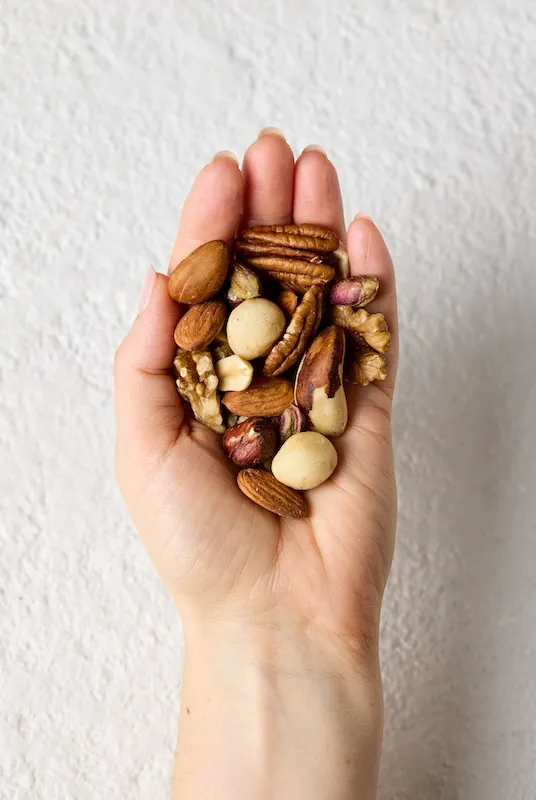
Nuts safeguard health in older people

Nuts safeguard health in older people
The results of an Australian study suggest that daily nut consumption may help safeguard health in older people, including in those with sub-optimal diets (1).
The large prospective cohort study was published in the journal Age and Ageing.
The first-of-its-kind study involved 9,916 older Australian men and women (≥70 years) who were living independently and were free of chronic disabling disease at the start of the study. They were tracked for just under four years.
It measured healthy life span – or ‘disability-free survival’ (DFS), a measure of survival, over the study period, without the onset of dementia or a major physical disability impacting basic activities of daily living.
Daily nut consumption was linked with a 23% lower risk of reaching the DFS endpoint (that is, dying or developing dementia or a major physical disability), compared to those who never or rarely ate nuts.
Older people who ate nuts every day or several times a day, regardless of the type or form of nut, lived longer without dementia or physical disability.
The findings were especially relevant for older people with less-than-optimal diets, highlighting the value of adding a handful of nuts every day, regardless of the overall ‘healthiness’ of a person’s diet.
What makes nuts so healthy?
The researchers say the nutrient-density of nuts makes them an important inclusion in the diets of older adults to delay age-related physical and cognitive decline.
Beneficial nut nutrients for healthy ageing include:
- Plant protein
- Unsaturated fats
- Fibre
- Vitamins, like folate, niacin, and vitamin E
- Minerals, including selenium, magnesium, calcium, and potassium
- Other bioactive compounds, like polyphenols and phytosterols.
Did you know? Nuts (with 3-6g protein/30g serve) may assist older adults to meet protein intake targets, which in Australia are 25% higher for adults aged over 70 years, to support maintenance of muscle mass (2).
The benefits of this unique nutritional profile are supported by consistent evidence linking nut intake with a lower risk of cardiovascular disease, cancer, cognitive decline, and mortality (3,4).
An in-depth research review, which combined the findings of 20 good-quality studies, found that people who ate 28g (a handful) of nuts a day had a 22% reduced risk of dying early, compared with people who almost never ate nuts (4).
Nuts for health: Further evidence in older people
Several key studies support the benefits of nuts for older people. For instance:
- A large US study found higher nut consumption to be strongly linked with a lower risk of frailty among older women (5). Specifically, those who consumed ≥5 serves of nuts per week (with a serve being 28g, or a handful) had a 20% lower risk of developing frailty, compared with those who ate less than one serve per month.
- A cross-sectional study, also in US adults (5,800 people aged 60+ years), found that those who ate at least 6.9g of nuts per day had fewer and less severe functional limitations, and were less likely to report poor general or physical health or trouble with daily activities, compared to people who didn’t eat nuts (6).
- A prospective study, involving 3,289 adults aged ≥60 years, showed a significantly lower risk of impaired agility and mobility in men, and a lower risk of impaired overall physical function in women, with higher nut consumption (≥11.5g/day), compared with those who didn’t eat nuts (7).
- A recent study involving 14,181 older adults living in China (with a mean age of around 85 years) found that participants who consumed nuts ‘almost every day’ had a 38% reduced likelihood of sarcopenia, compared with those who ‘rarely or never’ ate nuts (8). The study authors concluded that routinely integrating nuts into the diets of older adults could be an achievable way to support musculoskeletal health.
- In a recent systematic review, two out of four papers, looking at people aged ≥70 years, found a potential protective effect of nuts on cognitive function in women (9). In another recent study among Chinese people aged ≥60 years, regular nut consumption (≥70g/week) was linked with a 17% lower risk of cognitive decline (10).
- A recently-published international study analysed the diets, over up to 18 years, of more than 17,000 adults aged ≥45 years who were part of three long-running studies in the United States and the United Kingdom. It found even a small daily serve of nuts was linked with a lower risk of developing dementia, compared to not consuming nuts (11).
Did you know? Research suggests it’s never too late to make dietary changes. A dietary modelling study found that switching to an ‘optimal’ diet at the age of 60 could still result in an extra eight years of life, and even at 80, could extend life expectancy by more than three years (12). It also showed simple dietary changes in the right direction, even if not entirely ‘optimal’, can still boost life expectancy.
Did you know? A recent study found dentition or ‘dental issues’ was the most common reason given by Australians for avoiding nuts (13). Alternative forms, such as chopped nuts, nut butters and nut meals, are similar nutritionally to whole nuts, making them handy options for people with dental issues.
The bottom line:
Daily nut consumption can help safeguard health in older people, supporting a healthy lifespan in later life. The research findings can help guide older Australians in making dietary choices that can support health into older age. And for health professionals, they offer another evidence-based reason to recommend nuts. Nuts are a good choice for a snack or as part of a meal, and older people should aim for at least 30g (a handful) of nuts every day.
References
- Wild, H. et al., Nut consumption and disability-free survival in community-dwelling older adults: A prospective cohort study. Age and Ageing, 2024. 53(11). https://doi.org/10.1093/ageing/afae239
- Nutrient Reference Values for Australia and New Zealand including Recommended Dietary Intakes. NHMRC, Australia. Available at: https://www.eatforhealth.gov.au/nutrient-reference-values
- Balakrishna, R., et al. Consumption of nuts and seeds and health outcomes including cardiovascular, diabetes and metabolic disease, cancer, and mortality: An umbrella review. Advances in Nutrition, 2022. 13(6): 2136-48.
- Aune, D., et al. Nut consumption and risk of cardiovascular disease, total cancer, all-cause and cause-specific mortality: A systematic review and dose-response meta-analysis of prospective studies. BMC Med, 2016. 14:207.
- Wang, R., et al. Long-term consumption of nuts (including peanuts, peanut butter, walnuts, and other nuts) in relation to risk of frailty in older women: Evidence from a cohort study. J Nutr, 2023. 153(3):820-7.
- Feyesa, I., et al. Nut intake, functional limitations, and quality of life in older adults: Findings From NHANES 2003–2012. Journal of Cachexia, Sarcopenia and Muscle, 2025. 16(4): e70022.
- Arias-Fernández, L., et al. Prospective association between nut consumption and physical function in older men and women. J Gerontol A Biol Sci Med Sci, 2019. 74(7):1091-7.
- Xu, J., Association of nut consumption and sarcopenia in Chinese older adults. Sci Rep, 2025. 15(1):17598.
- Theodore, LE., et al. Nut consumption for cognitive performance: A systematic review. Adv Nutr, 2021. 12(3):777-92.
- Li, F., et al. Beneficial effects of nut consumption on cognitive function among elderly: Findings from a 6-year cohort study. Front Aging Neurosci. 2022, 14:816443.
- Zhao, M., et al. Nut consumption and long-term risk of all-cause dementia: Preliminary findings from three prospective cohort studies. Nutrients, 2026. 18:1722.
- Fadnes, LT., Estimating impact of food choices on life expectancy: A modeling study. PLOS Medicine, 2022. 19(3).
- Tran, G., Brown, RC., Neale, EP. Perceptions of nut consumption amongst Australian nutrition and health professionals: An online survey. Nutrients, 2022. 14:1660.

For information purposes only. ©2026 Nuts for Life